

Table of Contents
- Quick Comparison: Best Insect Repellent for Ranch Workers
- What Ranch Workers Actually Need From an Insect Repellent
- Best DEET-Free Repellent for Ranching: Ole Time Woodsman Fly Dope
- Heavy-Duty Tick Repellent for Farmers: Ranch and Farm Tick Dope
- How to Prevent Mosquito Bites While Working Outdoors
- Integrated Pest Management for Ranch Properties
- Conclusion: Choosing the Right Protection for Your Crew
- Frequently Asked Questions
Last Updated: September 13, 2026
Quick Comparison: Best Insect Repellent for Ranch Workers
The best insect repellent for ranch workers comes down to three things: how long it lasts, how it holds up against sweat, and whether it plays nicely with gloves, boots, and heavy canvas. A high-concentration natural formula applied to a hat brim and collar outperforms a weak spray reapplied every two hours. This guide from Ole Time Woodsman covers the formulas built for that job, plus how to layer them with gear and property management.
Quick Picks:
- Best Overall: Ranch and Farm Fly Dope ($59.95), 45% active ingredients, one application covers a full shift
- Best for Ticks: Ranch and Farm Tick Dope ($59.95), 14% cedarwood, geranium, rosemary, lemongrass, and citronella
- Best Value for a Crew: Fly Dope and Tick Dope Combo Special ($44.95), both formulas, free shipping
- Best for Chiggers: Chigger Dope ($24.95), 20% active ingredients, safe for people and pets
Here's the part most guides miss: ranch work isn't hiking. You're in tall grass, around livestock, and inside a leather glove for ten hours. That changes which product wins.

What Ranch Workers Actually Need From an Insect Repellent
A ranch-ready repellent is a long-duration, sweat-resistant formula that stays effective through a full work shift without constant reapplication. Three requirements separate it from a weekend spray.
First, residual protection. A product that fades in 90 minutes means stopping work to reapply, and nobody does that at hour seven (the EPA). Second, sweat resistance. Heat, labor, and chafing from gear strip a light formula fast. Third, compatibility. Repellent that degrades leather gloves or leaves a greasy film on a saddle is a liability, not a tool.
Long-Duration Efficacy for 10+ Hour Shifts
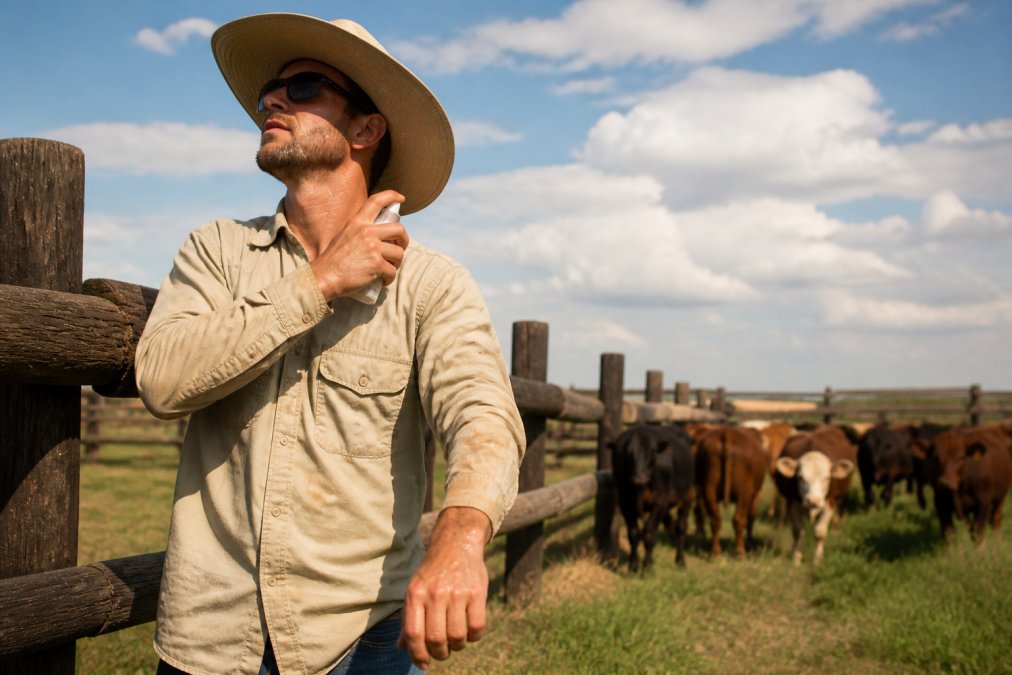
The biggest failure point in ranch insect protection is the reapplication interval. Most consumer sprays are formulated for a two-hour hike, not a ten-hour shift.
Experienced crews concentrate the product where insects actually orient: the hat brim, back of the neck, collar, and boot tops. Ole Time Woodsman's original Fly Dope was built on this principle, a few drops on a hat bill, bandana, and shoe laces will do the job. That lower-volume, higher-concentration strategy is why one small bottle lasts a full season of shifts rather than a weekend.

Compatibility With Work Gear
Repellent and work gear interact in ways most people don't think about until something is ruined.
That's the practical case for a botanical-based formula on a ranch. The Ole Time Woodsman line is built on natural oils, which is far gentler on leather, canvas, and cotton. If your gloves cost real money and your saddle cost more, that matters.
Best DEET-Free Repellent for Ranching: Ole Time Woodsman Fly Dope
The best DEET-free repellent for ranching is Ole Time Woodsman Fly Dope, a pine tar and citronella formula in continuous production since 1882. Its 45% active ingredients is unusually high for a botanical product and is the main reason it holds up across a long shift (the EPA).
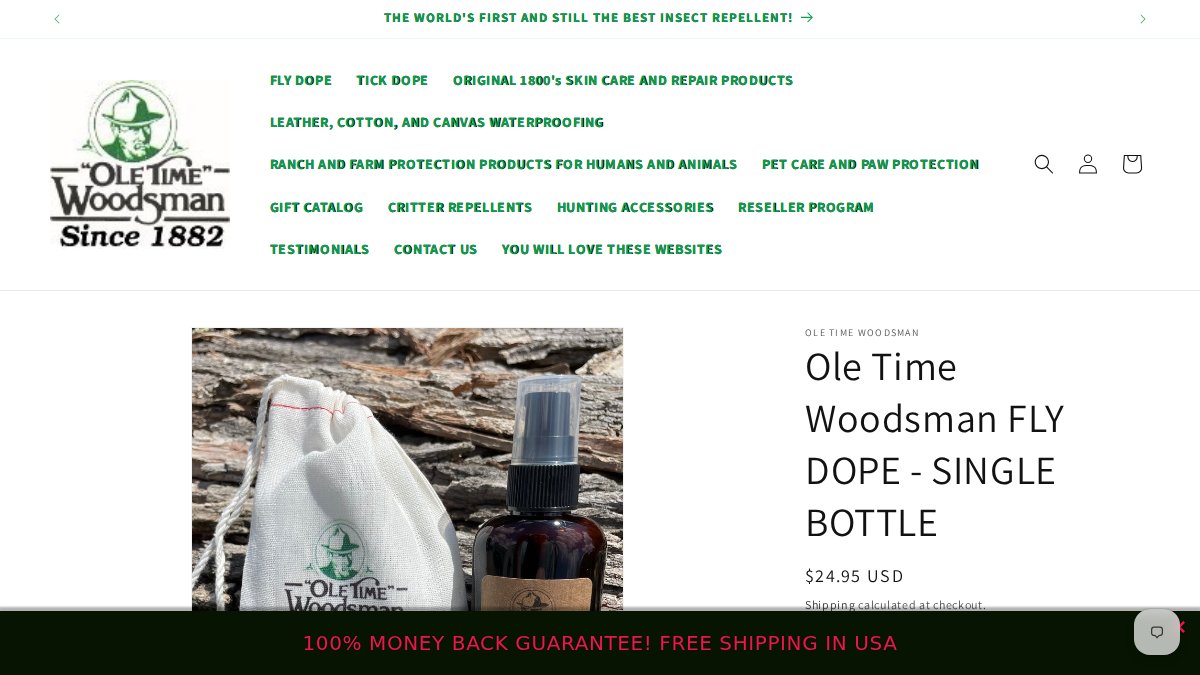
The active load is a heavy, low-volatility blend that evaporates slowly, exactly what you want when the alternative is reapplying every two hours.
Where it earns its place on a ranch: it works on black flies, deer flies, mosquitoes, and gnats, and it's safe on animals as well as people. Spray the forelocks and neck of a horse rather than the whole body; for yourself, a few drops on the hat brim and bandana.
The honest limitation: this is a pine tar product, and it smells like one. If you're sensitive to strong, smoky, resinous odors, it will take getting used to. It also comes in a large 8-ounce bottle at $59.95, a bigger commitment than a drugstore can, though the per-shift cost is lower.
Heavy-Duty Tick Repellent for Farmers: Ranch and Farm Tick Dope
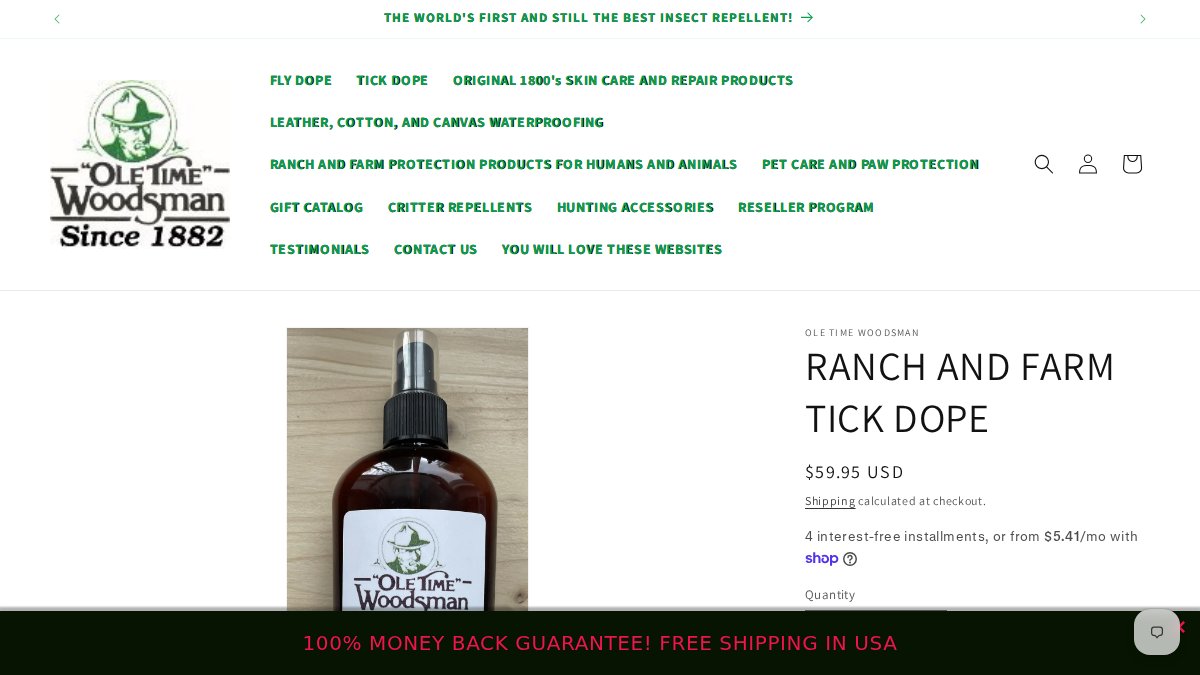
The best heavy-duty tick repellent for farmers is Ranch and Farm Tick Dope, a 14% active botanical formula built around the five plant oils ticks avoid. It costs $59.95 for an 8-ounce bottle and is safe for people and pets.

The active ingredients are cedarwood oil (4%), geranium oil (4%), rosemary (2%), lemongrass (2%), and citronella (2%). Each oil has a long practical history as a tick deterrent, and the combination is what Ole Time Woodsman has used since the formula was developed to match the original Fly Dope.
Why ticks deserve their own product: tick-borne illness is the real occupational risk on a ranch, not the itch. Blacklegged, lone star, American dog, and brown dog ticks all move through the same tall grass and brush your cattle do (the CDC). A repellent that only handles flying insects leaves the most serious hazard uncovered.
This is also the formula for pets and working dogs. The brand lists it as safe for animals, which matters when a herding dog is in the same pasture as the herd. Spray clothing and skin where ticks might enter, particularly pant cuffs, waistbands, and boot tops.
How to Prevent Mosquito Bites While Working Outdoors
Preventing mosquito bites while working outdoors means combining a slow-evaporating repellent with physical barriers and treating the property itself. No single product solves it alone. Trail advice breaks down on a ranch because the failure modes differ: on a hike, repellent fails because you sweat it off; on a ranch, you sweat it off and never stop moving long enough to notice the reapplication window has passed.
The layered approach that holds up on a working ranch:
- Treat clothing first. Spray pant cuffs, shirt cuffs, collar, and hat brim before you dress. Fabric holds repellent longer than skin and doesn't sweat it off. On a 10-hour July shift, this is the highest-leverage step, a treated collar keeps working at hour eight, while skin application is long gone.
- Cover the entry points. Long sleeves and pants aren't optional in heavy mosquito pressure. Tuck pants into boots or socks. Mosquitoes orient to the ankles and back of the neck first; those two zones account for a disproportionate share of bites on otherwise covered people.
- Apply to exposed skin last. Neck, ears, wrists, and the backs of hands are where bites land once clothing is handled.
- Reapply at midday if you've been sweating heavily. Even a slow-evaporating formula has limits under labor in heat. The practical trigger isn't a clock, it's the first bite landing on treated fabric.
- Address standing water on the property. Troughs, tires, and low spots breed mosquitoes continuously. Dumping them weekly cuts the population at the source.
Why Heat and Sweat Change the Math
Most consumer repellents are tested and marketed around a 2-to-4 hour activity window. Ranch work runs 10 to 12 hours, often in the hottest part of the day, and the labor means continuous sweat rather than bursts. Sweat dilutes the active ingredient at the skin surface and physically carries the product off the skin and into your clothing. A label reading "8 hours of protection" describes a sedentary test condition, not a fence-line condition.
That's why the concentrated, fabric-first strategy matters more on a ranch than anywhere else. A product applied to a hat brim, collar, and cuffs sits on fabric that stays in place and releases active ingredient slowly, rather than on skin sweating it away. The trade-off: you're relying on a scent and vapor barrier around your head and torso rather than a film on your arms. For mosquitoes and biting flies, that barrier does the work.
What Actually Fails on a Ranch
Three patterns show up repeatedly in crew experience:
- The diluted body spray. A light DEET or picaridin spray applied at 6 a.m. is gone by 9 a.m. under heavy sweat. Reapplying every two hours isn't realistic when you're moving cattle or fixing fence.
- The single application point. Treating only your neck and arms leaves the ankle and boot-top entry path open. Mosquitoes and ticks both use it.
- The all-skin approach. Misting exposed skin wastes product, increases absorption, and puts the repellent exactly where sweat removes it fastest.
For application, a concentrated formula like Fly Dope goes on fabric at the hat brim and collar rather than as a full-body mist. The brand's own line captures the logic: if they cannot find you, they cannot bite you.
Integrated Pest Management for Ranch Properties
Integrated pest management for a ranch property means reducing insect pressure at the source so personal repellent has less work to do. Repellent is the last line of defense, not the first. Competitors writing for hikers stop at "wear long sleeves and use DEET", they have no property to manage. On a ranch, the property is the problem, and the same land that supports cattle supports the insects that feed on the crew.
The four-part approach that fits a working property:
| Control Layer | What It Targets | Practical Action |
|---|---|---|
| Source reduction | Mosquito and fly breeding | Dump and scrub water troughs weekly; remove standing water |
| Habitat management | Tick and fly harborage | Mow tall grass along fence lines and paths; clear brush edges |
| Animal protection | Flies and ticks on livestock | Treat forelocks and necks; keep bedding dry and turned |
| Personal protection | Bites on workers | Concentrated repellent on fabric entry points, plus coverage |
The first two layers cost labor but no product. Mowing the fence line and clearing brush removes the shaded, humid cover ticks and biting flies need between hosts, and dumping troughs breaks the mosquito breeding cycle outright. Neither requires a purchase, just a schedule. Fold trough-dumping into the weekly water check and fence-line mowing into the seasonal rotation, so pest work rides along with chores you're already doing.
The Livestock-Safe Angle Most Guides Skip
The third layer is where animal-safe formulas earn their keep. A product you can use on both the herd and the crew simplifies purchasing and storage, one bottle in the barn rather than four. That matters for two reasons competitors rarely address.
First, application on animals differs from application on people. Label guidance for a botanical formula like Fly Dope is to spray the forelocks and neck of a horse rather than the whole body, targeting the spots flies actually congregate. Working dogs get the same logic: treat where ticks enter, not the entire coat.
Second, a shared product changes the economics. If the same formula handles the crew, horses, and herding dogs, you're buying one SKU instead of three, storing one bottle instead of a shelf, and training the crew on one set of instructions. When the person applying repellent at 5 a.m. is the same one treating a horse at noon, that consolidation is the difference between a product that gets used and one that sits in the tack room.
Where Personal Protection Fits
The fourth layer is you. Once the property is managed down, a concentrated repellent on your hat brim, collar, cuffs, and boot tops handles the insects that remain. The first three layers aren't meant to eliminate insects, just to reduce the population enough that one well-placed application holds through a full shift instead of failing by mid-morning.
There's also a gear-compatibility reason to keep the personal layer botanical. Where the same crew handles treated leather, canvas, and synthetic tack, a solvent-based repellent is a liability that a mineral-oil-carried botanical formula isn't.
Conclusion: Choosing the Right Protection for Your Crew
The hardest part of protecting a ranch crew isn't picking a product. It's picking one that survives a ten-hour shift, doesn't wreck your gear, and doesn't require a supply run every month.
For most operations, the answer is a concentrated, botanical formula applied to fabric entry points rather than a diluted spray applied to skin. Ole Time Woodsman has made that product since 1882, and the lineup covers the full ranch problem: Fly Dope for flies and mosquitoes at $24.95 a bottle or $59.95 for the large ranch size, Tick Dope for tick-borne illness risk, and Chigger Dope for the brush line. The Fly Dope and Tick Dope Combo Special at $44.95 gets both formulas to your door with free shipping.
Get started with Ole Time Woodsman and equip your crew with protection that lasts the whole shift, not the first two hours.
Frequently Asked Questions
What do farmers and ranch workers use to keep bugs away?
Most ranch workers use a combination of repellents, including DEET-free options like Ole Time Woodsman Fly Dope and Tick Dope. These products rely on natural ingredients such as pine tar, citronella, and cedarwood oil to mask human scent and deter biting insects. For heavy-duty tick protection, a dedicated tick repellent applied to clothing and skin is common. Many workers also treat workwear with permethrin for added defense. The best choice depends on the specific pests, shift length, and gear compatibility.
How can ranch workers prevent tick bites while working in tall grass?
Preventing tick bites starts with covering exposed skin, tucking pants into boots, and using a heavy-duty tick repellent for farmers like Ranch and Farm Tick Dope on clothing and skin. Apply repellent to pant cuffs, shirt collars, and socks. Reapply every 4 to 6 hours during peak tick season. After shifts, check your body thoroughly, especially behind knees, underarms, and hairline. Keeping grass mowed around work areas also reduces tick habitat.
Is DEET or Picaridin better for long-term outdoor work?
For ranch workers, DEET-free options like Ole Time Woodsman Fly Dope provide an alternative that avoids gear damage and skin sensitivity. The best choice depends on your priorities.
How often should ranch workers reapply insect repellent during a shift?
Reapplication depends on the formula and conditions. Most repellents need reapplication every 4 to 8 hours. For 10-hour shifts, plan to reapply at least once mid-shift, and more often if you sweat heavily or work in humid conditions. Always follow the product label for specific reapplication intervals and carry a small bottle for touch-ups.
What are the most effective natural insect repellents for heavy-duty use?
Effective natural repellents often combine multiple plant-based oils. Ole Time Woodsman Tick Dope uses cedarwood, geranium, rosemary, lemongrass, and citronella oils at 14% active ingredients to repel ticks. Fly Dope relies on pine tar, citronella, and camphor. These formulas are DEET-free and safe for people and pets. For heavy-duty use, choose a product with a high concentration of active ingredients and apply it to both skin and clothing. Reapply as needed for continuous protection.