

Table of Contents
- What Makes a Leather Conditioner Heavy Duty
- Best Leather Conditioner for Work Boots: What to Look For
- Natural Leather Conditioning Ingredients Explained
- How to Apply Leather Preservative Step by Step
- Buying Heavy Duty Leather Conditioner Online: Pricing and What to Expect
- Common Application Mistakes and Troubleshooting
- Conclusion
- Frequently Asked Questions
Last Updated: September 14, 2026
What Makes a Leather Conditioner Heavy Duty
A heavy duty leather conditioner penetrates deep into leather fibers, restores suppleness, and creates a protective barrier against water, salt, and abrasion. Unlike light lotions for dress shoes, heavy duty conditioners use concentrated waxes and oils that soak past the surface.
At Ole Time Woodsman, we've been mixing preservation wax since 1882, and the principle hasn't changed: leather is skin, and skin needs fat and wax to stay alive. When leather dries out, fibers stiffen, crack, and rot. A proper heavy duty conditioner reverses that and prevents dry rot before it starts.

Ingredients That Decide Performance
Four ingredient families do the real work in any heavy duty formula:
- Beeswax seals the surface and repels water without clogging leather pores
- Animal tallow (beef fat) feeds leather fibers and restores suppleness
- Fish oil penetrates deeply and carries other ingredients into the leather structure
- Pine resin adds tack and grip, which matters for boot soles and working gear
Skip anything built on petroleum distillates (pubmed.ncbi.nlm.nih.gov). Those feel soft at first, then dry leather out further because they strip natural oils instead of replacing them.
Best Leather Conditioner for Work Boots: What to Look For
The best leather conditioner for work boots combines deep fiber penetration with genuine waterproofing, and it should be safe for daily use on full-grain leather. Work boots take a beating dress shoes never see: mud, salt, concrete dust, repeated flexing at the toe box.
Look for these markers on the label:
- Beeswax or tallow listed in the first three ingredients
- No petroleum, silicone, or synthetic drying agents
- A consistency that softens when warmed in your hands
- Clear instructions for full-grain and tanned leather
Compatibility With Full-Grain and Tanned Leather
Not every heavy duty conditioner suits every hide. Full-grain leather has open pores and absorbs wax beautifully. Chrome-tanned leather, common in modern work boots, accepts most natural waxes but can darken slightly. Vegetable-tanned leather, used in saddlery and belts, drinks oil faster than any other type and needs lighter coats.
Here's the compatibility picture at a glance:
| Leather Type | Accepts Heavy Duty Wax | Watch Out For |
|---|---|---|
| Full-grain | Excellent | Slight darkening on first coat |
| Chrome-tanned | Good | Test on hidden area first |
| Vegetable-tanned | Excellent | Absorbs fast, apply thin |
| Suede / nubuck | Not recommended | Clogs nap permanently |
| Bonded / corrected grain | Poor | Wax sits on surface |
Test any new product on a small hidden patch, like the inside of a boot tongue, before treating the whole item.
Natural Leather Conditioning Ingredients Explained
Natural leather conditioning ingredients fall into two camps: fats that feed the leather and waxes that shield it. Traditional formulas combine both, which is why heritage recipes still outperform single-ingredient modern products. But "natural" isn't a guarantee of safety, castor oil is natural and darkens leather badly, and some plant oils go rancid in months.
The tanning process leaves leather chemically stable but thirsty. Over months of use, the oils added during tanning migrate out, and conditioners replace them. Which one you choose depends on the leather's tanning method, finish, and use.
Beeswax, Tallow, and Fish Oil: What Each One Does
Each ingredient plays a distinct role, and a good formula uses all three:
Beeswax forms the protective barrier, sitting in the leather pores and repelling water while still letting leather breathe. Too much wax alone makes leather stiff, which is why it's never used solo. Beeswax also causes the slight darkening on first application, temporary on most full-grain leather and fading as the wax works in.
Beef tallow is the conditioning workhorse. Its fat profile closely matches leather's natural oils, so fibers absorb it readily and regain suppleness. Tallow also resists rancidity better than most plant oils, which is why traditional boot formulas favor it over olive or coconut oil.
Fish oil is the penetrator. It's thin enough to carry wax and tallow deep into the fiber structure, which is why a proper treatment lasts through repeated soakings rather than washing off in the first rain. It's also the ingredient most likely to smell strong on opening, a sharp, marine odor that fades within a day. If a tin smells rancid rather than fishy, the oil has turned.
Pine resin, the fourth traditional ingredient, adds grip and helps the treatment stay put under flexing. Ole Time Woodsman's Dubbin Wax uses exactly this combination: beeswax, beef tallow, fish oil, and pine resin, with no synthetics or drying agents.

Natural vs. Synthetic: What the Label Doesn't Tell You
Most buyers assume "natural" means safer and "synthetic" means harsh. The reality is more nuanced: the ingredient list matters more than the marketing category.
Petroleum distillates (mineral oil, petrolatum, paraffin) are the most common synthetic base in cheap conditioners. They feel soft immediately because they coat the surface, but they don't penetrate fibers and strip natural oils over time, accelerating the drying they claim to fix.
Silicones (dimethicone, cyclopentasiloxane) create a slick, water-beading finish that looks impressive for a week, but they seal the leather's pores, trapping moisture and preventing breathing (pubmed.ncbi.nlm.nih.gov). On boots that see sweat and rain, silicone buildup commonly causes mildew and interior rot.
Plant oils (coconut, olive, neatsfoot, mink) are natural but vary widely. Neatsfoot oil penetrates well but can darken leather significantly and, in high concentrations, weaken stitching over years. Coconut and olive oils go rancid faster than tallow and attract dust. Mink oil is traditional but often cut with silicone in commercial products.
Lanolin, a natural wax from sheep wool, conditions well and resists water, but it can feel tacky and is a common allergen (pubmed.ncbi.nlm.nih.gov). It suits gloves and garments better than work boots that see grit.
Matching Ingredients to Leather Type
Ingredient choice should follow leather type, not the other way around:
- Full-grain and vegetable-tanned leather absorb tallow-and-wax formulas readily and benefit from the full traditional combination. Expect slight darkening on first coat.
- Chrome-tanned leather (most modern work boots) accepts natural waxes but may darken more than expected. Test on a hidden area first.
- Suede and nubuck should never see a wax or oil conditioner, the nap flattens permanently. Use a dedicated suede protector instead.
- Bonded and corrected-grain leather has a plastic surface coating that blocks absorption. Wax sits on top and looks greasy. These leathers need a light lotion, not a heavy-duty treatment.
- Exotic leathers (alligator, ostrich, shell cordovan) often have specific care requirements. Shell cordovan in particular responds poorly to heavy wax and prefers a light cream.
Sustainability and Toxicity: What to Ask
For buyers concerned about synthetic chemicals, the practical questions are simple:
- Is the full ingredient list disclosed? If not, assume the worst.
- Are the fats and waxes food-grade or cosmetic-grade? Tallow and beeswax sourced for cosmetic use are held to higher purity standards than industrial grades.
- Is the packaging reusable or recyclable? Metal tins are widely recyclable; plastic tubs often are not.
- Does the formula biodegrade? Traditional tallow-wax-fish-oil formulas break down naturally. Petroleum and silicone blends do not.
No chemistry degree required: a tin that names four recognizable ingredients and explains what each does beats one listing a dozen unpronounceable compounds under "proprietary blend."
How to Apply Leather Preservative Step by Step
Applying leather preservative correctly takes about 20 minutes per pair of boots, and technique matters as much as product. Rushing leaves surface residue that attracts dirt and never reaches the fibers.
Total time: 20-30 minutes per item Difficulty: Beginner
Tools You Need: Microfiber Applicator and Buffing Cloth
Gather these before you start:
- A microfiber applicator or clean lint-free cloth
- A separate buffing cloth (don't reuse the applicator)
- A soft brush for removing dried mud
- Warm water and mild soap for cleaning
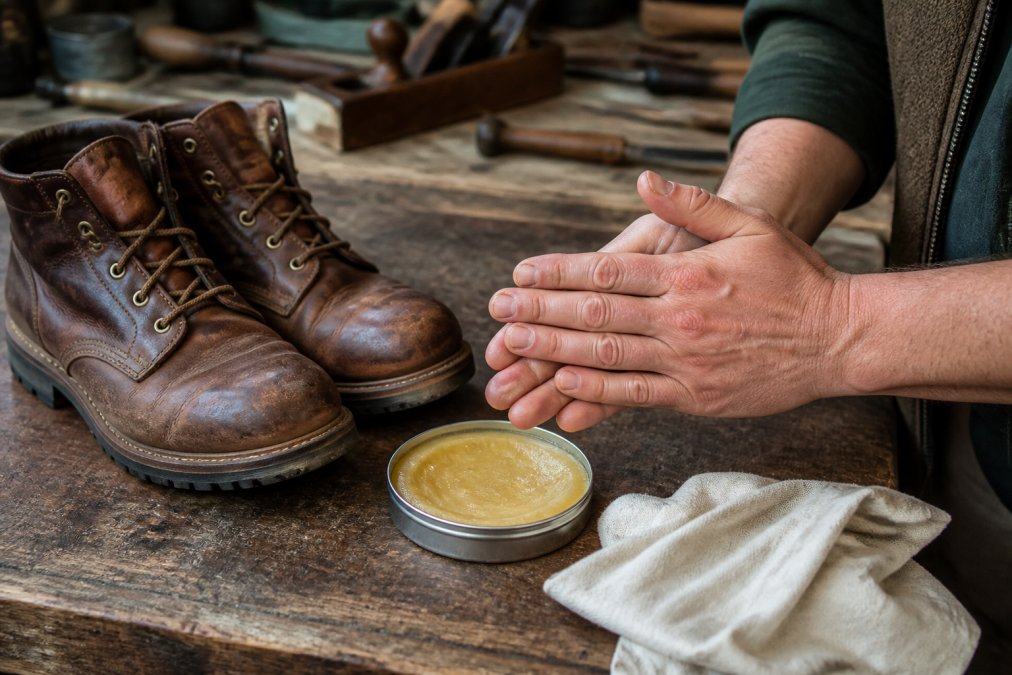
Step 1: Clean and dry the leather. Brush off loose dirt, wipe with a damp cloth, and let the leather dry completely. Conditioner traps grit against the surface if you skip this.
Step 2: Warm the product. Rub the wax between your fingers or set the tin in warm water. Warm conditioner spreads thinner and penetrates deeper.
Step 3: Apply a thin coat. Work the conditioner into the leather with the microfiber applicator in small circles. Pay attention to seams, flex points, and the toe box.
Step 4: Let it absorb. Give the leather 10-15 minutes to drink in the treatment. If areas still look dry, add a second thin coat rather than one heavy one.
Step 5: Buff off the excess. Use the clean buffing cloth to wipe away surface residue. This step prevents the sticky finish that collects dust.
Expected result: Leather should feel supple, look slightly darker, and shed water when tested with a few drops.
Buying Heavy Duty Leather Conditioner Online: Pricing and What to Expect
Online pricing for heavy duty leather conditioner runs from about $10 for small tins of unknown formulation up to $40 or more for heritage brands with full ingredient disclosure. The real variable isn't the price tag but cost per application, how many pairs of boots, saddles, or gloves a tin actually treats.
A quality wax treatment covers multiple pairs of boots per tin because you apply it thin. Cheap products often need heavy application to show any effect, so you buy more and still get a sticky finish. Run the math: divide tin price by realistic applications, not by the ounce count on the label.
Cost Per Application: The Number That Actually Matters
A 3-ounce tin applied thin typically treats 6 to 10 pairs of boots, depending on dryness and surface area. That's roughly $3 to $5 per pair for a mid-priced heritage product, versus $8 to $12 per pair for a cheap tin needing a heavy coat. The cheaper tin is rarely cheaper.
Ole Time Woodsman's Boot Grease, the original 1800s formula for preservation wax and waterproofing, is priced at $29.95 and covers roughly eight pairs of boots per tin based on customer reports. The Dubbin Wax Gift Pack runs $39.95 and includes the same traditional formula in a presentation box.

What to Verify Before You Check Out
When buying online, check five things before you commit:
- Full ingredient list, not just marketing claims. If the seller won't name what's in the tin, assume petroleum distillates or silicone.
- Tin volume and net weight, listed in ounces or grams. A "large" tin with no weight is a red flag.
- Clear application instructions on the product page, including which leather types the formula suits.
- Return policy, since leather darkening is a common concern and a seller who won't accept returns is telling you something.
- Seller identity and shipping origin, especially on marketplace listings where third-party resellers may ship old stock or counterfeit tins.
Shipping, Storage, and Shelf Life
Wax-based conditioners are stable for years when stored cool and sealed. Heat is the enemy: a tin left in a hot truck or garage over summer can separate, and fish-oil formulas turn rancid above room temperature for long periods. If a tin arrives soft, oily, or smelling sharp, contact the seller before using it.
Order in cooler months when possible, and avoid sellers who ship wax products in uninsulated packaging during heat waves. Once a tin is open, keep the lid sealed and store it away from direct sun. A properly stored tin of traditional dubbin lasts several seasons.
Common Application Mistakes and Troubleshooting
Most conditioning failures trace back to technique, not product. The mistakes repeat across nearly every leather type.
Mistake 1: Applying to dirty leather. Dirt gets pushed into the pores and creates a grinding paste. Always clean first.
Mistake 2: Using too much product. A thick coat sits on the surface, stays tacky, and attracts dust. Thin coats, repeated, always beat one heavy application.
Mistake 3: Skipping the buff. Unbuffered residue feels greasy and stains pants and socks. Buff until the leather feels dry to the touch.
Mistake 4: Conditioning wet leather. Water blocks absorption. Let leather dry fully, then condition.
Mistake 5: Treating suede or nubuck. Wax conditioners flatten the nap permanently. Use a dedicated suede protector instead.
If leather still feels stiff after treatment, it was too dry for a single session. Apply another thin coat after 24 hours. For cracked leather repair, repeated light treatments over several days beat one aggressive application, because fibers need time to rehydrate without becoming oversaturated.
Conclusion
Leather gear fails for one reason: it dries out faster than it gets fed. Choosing the right heavy duty leather conditioner online comes down to reading ingredients, matching the formula to your leather type, and applying it with patience rather than volume.
Ole Time Woodsman has been mixing these formulas since 1882, using fish oil, pure beeswax, organic beef tallow, and pine resin with no synthetics or drying agents. The Boot Grease and Dubbin Wax lines cover work boots, saddlery, gloves, and canvas gear.
Get started with Ole Time Woodsman and give your leather the kind of long-term care that keeps it working for decades, not seasons.
Frequently Asked Questions
Does heavy duty leather conditioner darken leather?
Most heavy duty leather conditioners will darken leather slightly because the oils and waxes penetrate the leather fibers and add moisture. The darkening is usually temporary and fades as the conditioner absorbs over a few days. If you want to minimize darkening, apply a thin coat, let it sit for 20 minutes, then buff off any surface residue with a clean cloth. Formulas made with beeswax and tallow tend to darken less than those with heavy petroleum or silicone content.
How often should you apply heavy duty leather conditioner?
For work boots used daily in wet or muddy conditions, apply every 4 to 6 weeks or whenever the leather feels dry. For occasional outdoor gear, two to three times per year is enough. If you notice the leather absorbing the conditioner quickly or surface residue disappearing within minutes, that is a sign the leather needs more frequent conditioning. Over-conditioning can clog leather pores and attract dirt, so stick to a schedule based on use.
What is the difference between leather oil and leather preservative?
Leather oil is a liquid that penetrates deep into the leather fibers to restore suppleness and hydration. Leather preservative is a thicker wax-based product that sits closer to the surface and creates a protective barrier against water, salt, and element repellency. For heavy-duty protection on work boots and outdoor gear, a preservative wax like Dubbin Wax or Boot Grease offers better weatherproofing. Oils are better for restoring very dry leather before sealing with a wax.
Can you use heavy duty leather conditioner on all types of leather?
No. Heavy duty conditioners work best on full-grain leather, oiled leather, and smooth finished leather used for work boots and outdoor gear. Avoid using them on suede, nubuck, or patent leather because the waxes can flatten the nap or leave a greasy film. Always test on a small hidden area first. If the leather is bonded or synthetic, check the manufacturer's guidance before applying any conditioning oil or wax product.