

Table of Contents
- Why Look for a Nikwax Alternative for Leather Gear
- Traditional Wax vs. Synthetic Waterproofers: What Changes
- The Best Leather Waterproofing Wax Options Compared
- How to Apply Beeswax to Leather Gear Step by Step
- Leather Gear Maintenance Tips for Long-Term Care
- Cost Breakdown: What You Pay Per Treatment
- Conclusion
- Frequently Asked Questions
Last Updated: September 21, 2026
Why Look for a Nikwax Alternative for Leather Gear
A nikwax alternative for leather gear matters because leather is animal skin, and the synthetic detergents and water-based polymers in many modern waterproofers sit on top of it rather than feeding it. At Ole Time Woodsman, we have watched this since 1882: gear fed natural waxes outlasts gear sprayed with chemistry.

Traditional Wax vs. Synthetic Waterproofers: What Changes
Traditional wax feeds leather from the inside out, while synthetic waterproofers form a surface film that blocks water without restoring the material beneath. Both can work. Only one keeps leather supple.
How Water-Based Formulas Interact With Leather
Water-based waterproofers deposit a polymer layer inside the leather pores that repels water well at first. But each reapplication adds another layer, clogging pores and killing breathability. On full-grain leather this shows up as a dull, plasticky surface within a year; on oil-tanned leather it can lift the finish unevenly.
What Wax-Based Treatments Do Differently
Wax-based treatments reverse that order: oil first, then wax to lock it in.
The Best Leather Waterproofing Wax Options Compared
The best leather waterproofing wax for most people is a beeswax-and-tallow formula applied warm, because it conditions and waterproofs in one step without synthetic additives. Here is how the options stack up.
| Product | Ingredients | Size | Price | Best For |
|---|---|---|---|---|
| Ole Time Woodsman Boot Grease | Beeswax, beef tallow, cod oil, pine resin | 8 fl oz | $29.95 | Work boots, saddles, heavy leather |
| Dubbin Wax | Beeswax, beef tallow, fish oil, pine resin | Standard tin | $29.95 | Gloves, jackets, general leather care |
| Dubbin Wax Gift Pack | Same formula plus dauber and bag | Full tin + tools | $39.95 | Gifts, first-time wax users |
| Boot Grease Gift Pack | Same formula plus brush and bag | Large can | $39.95 | Households with multiple pairs |
| Oilskin Wax, Quart | Beeswax, fish oil, beef tallow, pine resin | 32 fl oz | $89.95 | Canvas, cotton, tarps, tents |
Boot Grease and Dubbin Wax: Ingredients and Coverage
Boot Grease and Dubbin Wax share a core idea but differ in finish.


How to Apply Beeswax to Leather Gear Step by Step
Applying beeswax to leather takes five steps and about 45 minutes per item, plus an hour of curing.
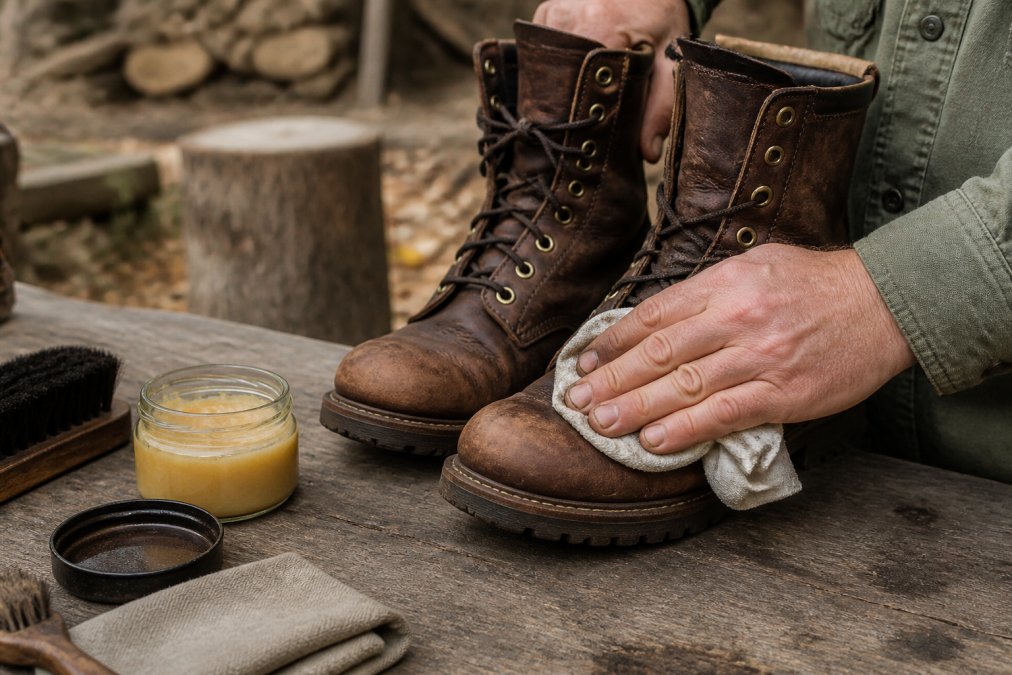
What You'll Need:
- Beeswax-based wax or grease
- A clean cloth or horsehair dauber
- A soft buffing cloth
- A hair dryer or warm room
- Mild soap and water for cleaning
Leather Gear Maintenance Tips for Long-Term Care
Leather gear maintenance comes down to three habits: clean it before it dries out, feed it before it cracks, and reapply before the season starts. Longevity is built on timing, not product volume.
- Reapply every 3 to 6 months for gear in regular outdoor use, and before every hunting or hiking season.
- Clean after every wet exposure. Salt, mud, and road grime pull oils out of leather faster than rain does.
- Store dry and cool. Never store leather in a sealed plastic bag; it needs air movement to avoid mildew.
- Rotate your footwear. Giving boots a full day to dry between wears can extend their service life.
- Check seams and stitching. Stitching rots when leather stays damp, and a failed seam leaks no matter how well the leather is sealed.
Leather Compatibility: What Each Type Can Take
Most guides treat "leather" as one material. It is not, and the wrong product on the wrong hide ruins gear. Here is the compatibility picture.
Ole Time Woodsman Boot Grease. The →
| Leather Type | Wax-Based Treatment | Water-Based Spray | Notes |
|---|---|---|---|
| Full-grain / smooth | Yes, best results | Acceptable, short-lived | Wax feeds the fiber; sprays sit on top and dull the finish over time |
| Oil-tanned | Yes, ideal | Can lift the finish unevenly | Wax blends with existing oils; sprays can streak |
| Suede / nubuck | Use sparingly, thin coats | Only if labeled suede-safe | Nap is fragile; test on a hidden area first |
| Patent / finished | No | No | Wax dulls the finish; most treatments ruin the shine |
| Bonded / corrected-grain | Yes, but low value | Acceptable | The surface is a coating, not hide; conditioning does little |
How Treatments Affect Longevity Over 5+ Years
- Wax-treated leather typically stays supple because the oils replace what use and weather strip out. Stitching stays intact longer because the leather around it does not dry and shrink against the thread.
- Spray-treated leather often stiffens at flex points, the toe crease, the ankle, the palm, because repeated polymer layers clog pores and the underlying fiber dries out. Once the leather cracks at a flex point, no coating repairs it.
- Mixed routines (spray for waterproofing, oil for conditioning) can work, but the spray layer interferes with how evenly the oil absorbs, so results are inconsistent.
If you are coming from a spray-on product, expect the first wax treatment to feel slower. It is. It can also last longer, reducing the frequency of re-application.
Cost Breakdown: What You Pay Per Treatment
Cost per treatment is the number that actually matters, and wax wins by a wide margin. An 8 fl oz can of Boot Grease at $29.95 covers up to eight pairs of boots. The Dubbin Wax Gift Pack at $39.95 adds a horsehair dauber and storage bag to a full tin; the Boot Grease Gift Pack at $39.95 includes a brush and heavy-duty cotton drawstring bag, and the large can covers up to eight pairs.
DIY and Household Alternatives: What Actually Works
If the goal is the lowest possible cost per treatment, a few household and DIY options are worth knowing. None match a formulated wax-and-oil blend, but they can be fallbacks when a tin runs out or a budget is tight.
- Beeswax and a carrier oil. A common home blend is roughly equal parts beeswax and a food-grade oil such as olive or coconut oil, melted together in a double boiler and poured into a tin. It conditions and repels water reasonably well, but without pine resin or tallow it may not bond as deeply and may need more frequent reapplication.
- Sno-Seal-style beeswax products. Widely available at outdoor retailers and hardware stores, these are the closest off-the-shelf equivalent to a traditional wax treatment and are a fair benchmark for price comparison.
- Mink oil. Conditions well and is inexpensive, but it darkens leather noticeably and offers weaker water repellency than wax. It is a conditioner first, a proofer second.
- Coconut oil alone. Works as a light conditioner for smooth leather, but does not form a durable water-repellent layer and can go rancid in warm storage, a stopgap, not a routine.
- What does not work: petroleum jelly, motor oil, silicone caulk, and cooking spray. These either clog pores, damage stitching, or leave a residue that attracts dirt. Skip them.
The Real Cost Comparison
Here is the honest arithmetic across a season for a household with two pairs of boots, a pair of gloves, and a jacket:
- Wax routine: one $29.95 tin covers all of it for a full year, with product left over.
- Spray routine: a typical aerosol or pump proofer runs $10-$20 per can, covers one to two items, and needs reapplication every few weeks during wet season. Across a full season, that is easily $60-$100 for the same gear.
- DIY blend: roughly $8-$15 in raw materials for a batch that treats several items, but with shorter intervals between applications and more time invested.
Conclusion
The hard part is not choosing a wax. It is accepting that waterproofing leather is a maintenance habit, not a one-time purchase. Gear fed every few months can outlast gear sprayed once and forgotten, and the cost per treatment can favor wax.
Frequently Asked Questions
What can I use instead of Nikwax for leather boots?
Wax-based treatments made from beeswax, tallow, fish oil, and pine resin are the most common alternative. These ingredients feed the leather while forming a water-repellent barrier, unlike water-based synthetic formulas that sit on the surface. Ole Time Woodsman Boot Grease uses this exact combination and costs $29.95 for an 8 fl oz can, enough to treat roughly eight pairs of boots.
Is beeswax safe for all types of leather?
Beeswax works well on full-grain, oil-tanned, and smooth leather. It can darken lighter leathers slightly, so test a small area first. Avoid using heavy wax on suede or nubuck because it flattens the nap and changes the texture. For those delicate types, a lighter spray or dedicated suede protector is a better match.
How often should I re-apply leather waterproofing wax?
For boots worn daily in wet conditions, re-apply regularly. Gear used occasionally can go longer between treatments. A simple test: drop water on the leather. If it soaks in instead of beading up, it is time to re-wax. Regular conditioning keeps leather supple and prevents cracking.
Can I use the same wax on leather and canvas gear?
No. Leather needs animal-fat-based waxes that absorb into the pores, while canvas and cotton require a different formula. Ole Time Woodsman Oilskin Wax ($89.95 for a 32 fl oz quart) is made for canvas and cotton garments, tents, and bags. Using leather grease on canvas leaves a sticky residue that attracts dirt and does not absorb properly.
What makes traditional wax better than synthetic waterproofers for gear longevity?
Synthetic waterproofers create a surface coating that wears off and can dry out leather over repeated use. Wax-based treatments absorb into the leather, replacing natural oils and keeping fibers flexible. This dual action of conditioning and waterproofing can extend the life of boots, saddles, and gloves. The trade-off is that wax requires more effort to apply and may need warming first.