

Table of Contents
- Why Natural Wax Beats Synthetic Conditioners
- How Natural Wax Waterproofs Leather Without Trapping Moisture
- How to Waterproof Leather Boots Naturally
- Best Natural Leather Conditioner for Outdoor Gear
- How to Clean and Condition Leather
- Restoring Stiff, Dry, and Cracked Leather
- Risks and Downsides of Natural Wax
- Conclusion
- Frequently Asked Questions
Last Updated: September 23, 2026
Why Natural Wax Beats Synthetic Conditioners
Natural wax works with leather's biology instead of against it. Leather is animal skin, and it stays supple only when it receives the same kinds of fats and oils that kept it flexible in life. This is the core reason why use natural wax on leather has stayed the standard for centuries, and why Ole Time Woodsman has built its leather care line around it since 1882.
What's Actually in Natural Leather Wax
A traditional formula reads like a short recipe, not a chemical inventory. Ole Time Woodsman Boot Grease contains only pure beeswax, tallow, cod oil, and pine resin. Each ingredient does a specific job:

- Beeswax forms the moisture barrier and gives the leather its water-resistant finish
- Beef tallow restores the fats that leather loses through use and weather
- Cod oil carries the wax deep into the leather fibers
- Pine resin seals the surface and adds shine
How Natural Wax Waterproofs Leather Without Trapping Moisture
The trick is penetration, not coating. A thin layer of wax on top of leather will bead water for a week and then flake off. Wax that has been drawn into the leather fibers by warmed oil creates a moisture barrier from the inside out. Water stays out. Moisture vapor from your foot can still escape through the leather's pores, which is why waxed leather breathes while plastic-coated leather does not.
How to Waterproof Leather Boots Naturally
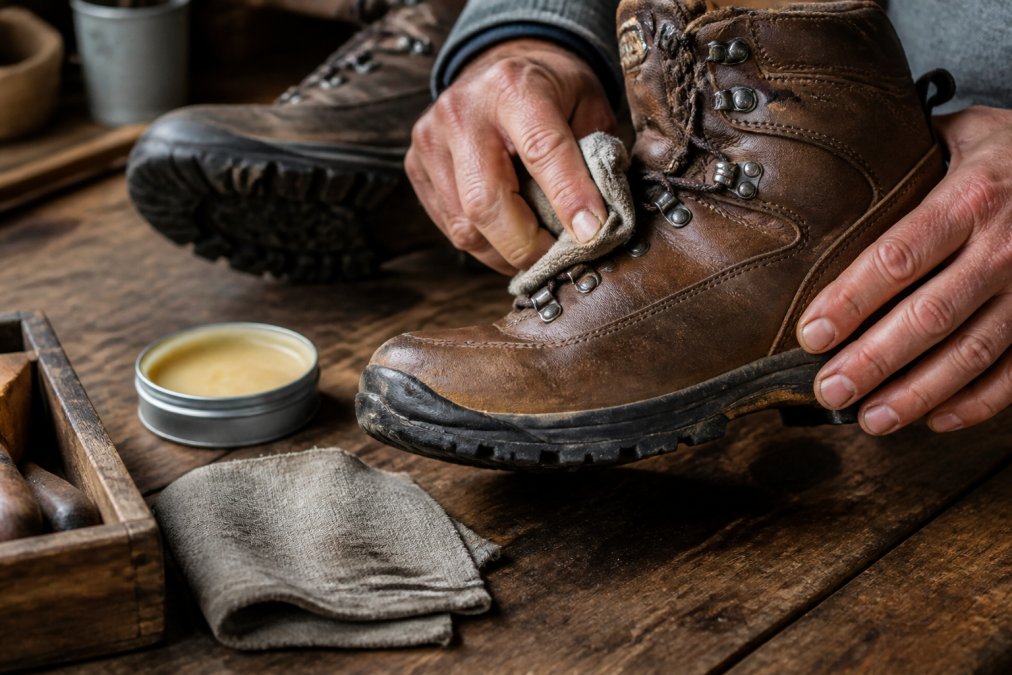
Waterproofing leather boots naturally takes about 30 minutes plus drying time, and it starts with clean, dry leather. Skip the cleaning step and you will trap grit in the grain, which grinds away at the finish every time you walk.
Step-by-Step Application
- Clean the boots. Brush off dried mud and dust with a stiff brush, then wipe the leather with a damp cloth. Let them dry completely, away from direct heat.
- Warm the wax and the leather. Gently warm the tin so the grease softens, and warm the boots so the pores open.
- Apply a thin coat. Work a small amount into the leather with your fingers or a cloth, using circular motions. Pay attention to seams, welt lines, and the flex point at the toe, since these are where water enters first.
- Let it sit. Give the leather an hour to absorb the oils and wax.
- Buff off the excess. Rub the surface with a clean cloth until it is dry to the touch, not tacky.
- Reapply seasonally. Two to four treatments a year keeps working boots protected. Gear that sees daily mud and snow needs more.
Expected result: Water beads on the surface instead of soaking in, and the leather feels supple rather than stiff.
Best Natural Leather Conditioner for Outdoor Gear
The best natural leather conditioner for outdoor gear is one built on animal fats and waxes rather than petroleum derivatives, because outdoor gear faces the exact conditions that break down synthetic coatings: repeated wet-dry cycles, abrasion, and UV exposure. Ole Time Woodsman Boot Grease fits that description at $29.95 for an 8 fl oz can, and a single can covers up to eight pairs of boots.
| Product | Price | Key Ingredients | Best For |
|---|---|---|---|
| Boot Grease | $29.95 | Beeswax, tallow, cod oil, pine resin | Boots, saddles, heavy work leather |
| Dubbin Wax | $29.95 | Beeswax, tallow, fish oil, pine resin | Smooth leather, dress and work boots |
| Boot Grease Gift Pack | $39.95 | Same formula plus brush and bag | Gifts, full gear kits |
| Dubbin Wax Gift Pack | $39.95 | Same formula plus dauber and bag | Gifts, detail work |
How to Clean and Condition Leather
Cleaning and conditioning leather is a two-part process, and most damage comes from skipping the first part. Dirt left in the grain acts like sandpaper under every flex. Wipe the surface with a damp cloth and a mild soap if needed, then let the leather dry naturally. Never dry leather near a radiator, a fire, or a heater vent. Heat drives out the natural oils faster than any wax can replace them.
Restoring Stiff, Dry, and Cracked Leather
Stiff leather is dehydrated leather, and it can usually be brought back. The fibers have lost the oils that kept them pliable, so they lock together and resist bending. Warm the leather gently, then work a fat-rich wax into it in thin layers over several days. The tallow and oil in a traditional formula soak in and separate the fibers again.
Risks and Downsides of Natural Wax
Natural wax is not risk-free, and honest guides say so. The difference between a treatment that helps and one that ruins a piece of leather usually comes down to matching the product to the finish, not to the wax itself. Here is a decision framework for when to wax, when to proceed with caution, and when to walk away.
Ole Time Woodsman Boot Grease. The →
When NOT to Use Wax
Some leathers should never see a wax-based product. Applying one is not a minor mistake, it can be permanent.
- Suede and nubuck. These finishes are made by buffing the grain side (nubuck) or the flesh side (suede) to raise a soft nap. Wax mats the nap flat, darkens it unevenly, and clogs the fibers. Once matted, the nap rarely recovers fully. Use a suede brush, a suede eraser, or a dedicated suede protector instead.
- Patent and high-gloss finishes. Patent leather has a plastic or lacquer coating over the grain. Wax cannot penetrate the coating, so it sits on top, dulls the mirror finish, and attracts dust. Wipe patent with a damp cloth and leave it alone.
- Aniline and pure aniline leather. These are dyed-through, unfinished leathers with no protective topcoat. They absorb everything, including wax, unevenly. A wax treatment can leave blotchy dark patches that never even out. Use a purpose-made aniline conditioner and test on a hidden area first.
- Exotic leathers with delicate scales. Snakeskin, lizard, and similar leathers have scales that can lift or discolor under a heavy wax. If you must treat them, use a formulation made specifically for exotics and apply the thinnest possible coat.
- White or very light leather. Beeswax and tallow are amber to yellow. On white leather, even a clear-looking wax can leave a yellow cast over time as the oils oxidize.
Proceed With Caution
These situations are not dealbreakers, but they call for a test patch and a lighter hand.
- Light-colored dress leather. Darkening is the most common complaint. Test on the heel or tongue first, and expect some deepening of the color regardless of what the label claims.
- Leather with a factory finish or acrylic topcoat. The wax may not penetrate at all and will instead sit on the surface, where it can look streaky. A light coat buffed thoroughly is the only safe approach.
- Antique or collectible leather. Any treatment changes the surface. On a piece with historical or resale value, the safest move is often no treatment at all.
The Real Downsides, Even on Suitable Leather
Even when wax is the right call, it comes with trade-offs worth knowing before you open the tin.
- Darkening. Beeswax and tallow deepen the color of leather, sometimes noticeably. On work boots that is a feature. On a light-colored dress shoe it may not be.
- Patina change. Waxed leather ages with a matte, lived-in look rather than a factory shine. Over months and years, natural wax develops a depth and character that synthetic coatings cannot replicate, but it is a different look, and it is not reversible.
- Over-application. Too much wax clogs the pores and reduces breathability, the opposite of the goal. Thick coats also attract grit, which abrades the finish from the inside. Two thin coats beat one heavy one every time.
- Slippery finish. A heavy coat on smooth leather or smooth soles can feel slick until it is buffed down. Buff until the surface is dry to the touch, not tacky.
- Attraction of dust and lint. A tacky, under-buffed surface grabs dust. This is a buffing problem, not a wax problem, but it is the most common user error.
The Environmental and Safety Profile
On the environmental side, the picture is favorable. Beeswax, carnauba, tallow, and pine resin are renewable and biodegradable, and they carry no petroleum solvents. That matters for two reasons. First, whatever you put on your hands during application ends up on your skin, natural waxes are generally recognized as safe for incidental contact, while petroleum distillates carry handling warnings. Second, runoff from treated gear eventually reaches soil and water.
Conclusion
Leather asks for the same care it received when it was still on the animal: natural fats, natural waxes, and regular attention. Synthetic shortcuts buy a season at best and cost you the leather at worst. Ole Time Woodsman has made the traditional alternative since 1882, and the Boot Grease formula still contains nothing but beeswax, tallow, cod oil, and pine resin.

Frequently Asked Questions
Which is better for leather, oil or wax?
Oil and wax serve different purposes. Oils penetrate deep into leather fibers to restore suppleness, while natural wax leather treatments sit closer to the surface, creating a protective coating that repels water and blocks stains. For outdoor gear that faces rain, mud, and snow, wax-based products like Ole Time Woodsman Boot Grease provide better water resistance. Many traditional formulas, including those dating back to the 1800s, combine both: oils carry the wax into the leather, and the wax stays behind to shield it.
Does natural wax waterproof leather effectively?
Yes, natural wax creates a water-resistant barrier on leather surfaces. Beeswax, a key ingredient in traditional leather wax, fills the leather pores and forms a protective coating that causes water to bead and roll off. Pine resin adds durability to that barrier, helping it withstand repeated exposure to wet conditions. No treatment makes leather fully submersible, but a properly waxed boot or saddle will shed rain and keep your feet dry through extended outdoor use.
How often should you apply wax to leather boots?
Apply natural wax leather treatment every three to six months for regular use, or more often if you wear your boots in wet, muddy conditions. A good rule: if water no longer beads on the surface, it's time to reapply. Clean the leather first with a damp cloth, let it dry completely, then warm the wax slightly and work it in with your fingers or a cloth. Buff off the excess after an hour. Boots used daily in harsh conditions may need waxing monthly.
What should you not use on leather?
Avoid products containing mineral oil, paraffin, neatsfoot oil, or synthetic chemicals. These can clog leather pores, dry out the fibers over time, and damage stitching. Mineral oil and paraffin sit on the surface without absorbing, while harsh solvents strip the leather's natural oils. Stick with natural ingredients like beeswax, beef tallow, cod oil, and pine resin. Traditional formulas such as Ole Time Woodsman Boot Grease use only these time-tested ingredients, which work with leather's natural state instead of against it.